
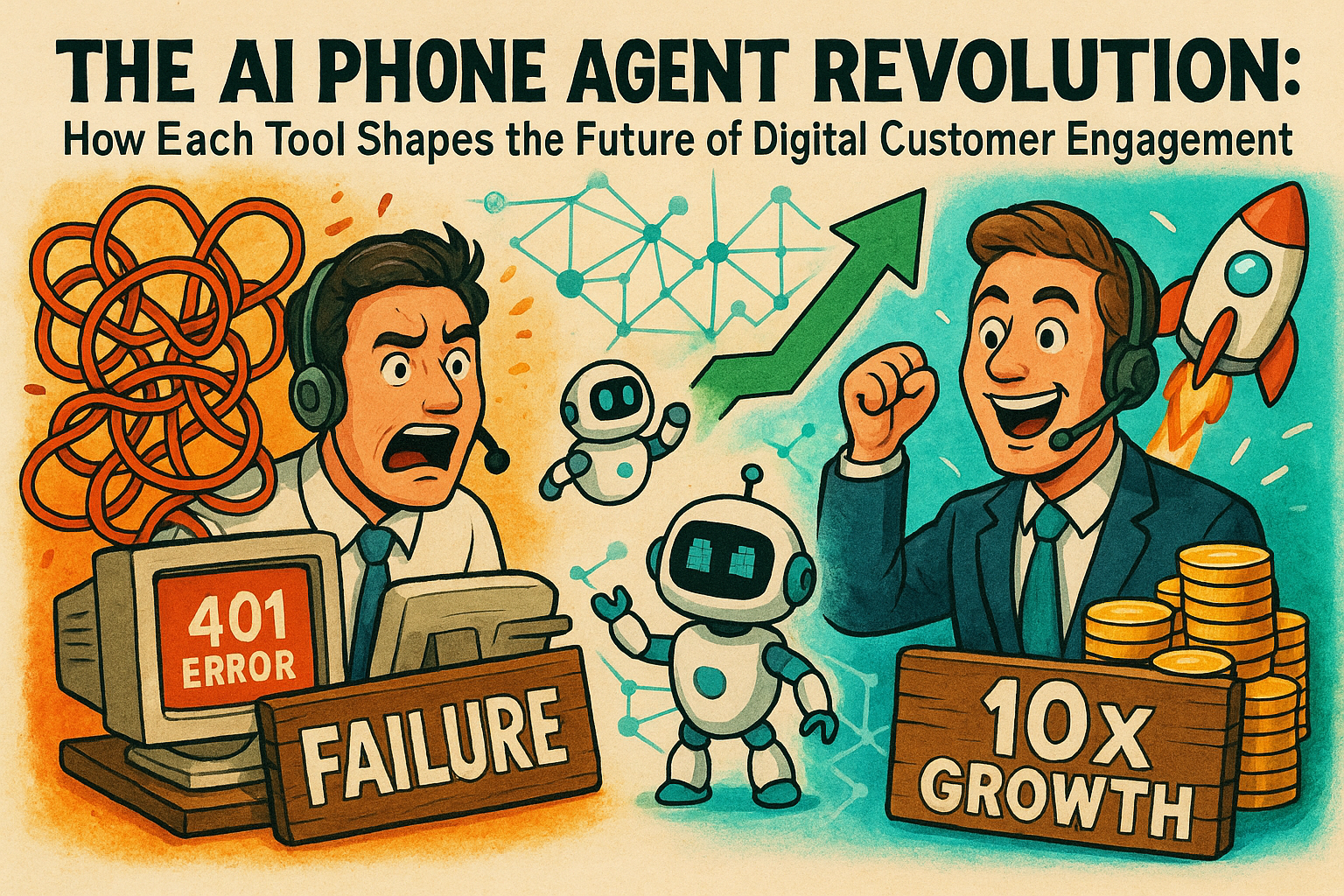
In the fast-evolving digital landscape, one truth stands clear: the customer conversation has become the new currency of marketing. For marketing directors navigating omnichannel strategy, the rise of AI phone agents represents a seismic shift in how brands engage, convert, and retain their customers. The question is no longer whether to integrate AI-driven communication but which AI phone system best aligns with your brand’s growth model. Today, we’ll cut through the noise and offer a tool-by-tool comparison of the major players transforming the digital telecom space—culminating in why ezdial.ai stands out as the strategic choice for forward-thinking enterprises.
The Evolution of AI Communication: From Call Centers to Conversational Intelligence
To understand the excitement surrounding AI phone agents, let’s take a step back. The traditional call center was once the nerve center of customer interaction. It demanded scale, manpower, and massive infrastructure investments. However, as digital transformation accelerated, these analog legacies started showing cracks—high costs, long waiting times, inconsistent scripts, and poorly integrated customer data. The modern customer, with their digital-first mindset, demands immediacy, personalization, and efficiency. Enter AI phone agents: intelligent systems capable of human-like conversation, real-time analytics, and predictive engagement.
This evolution marks a turning point. AI no longer just supplements human operators—it optimizes, personalizes, and scales every customer touchpoint. What we’re witnessing is not just automation; it’s the strategic redefinition of voice communication itself.
Tool-by-Tool Analysis: Who’s Leading the AI Phone Agent Race?
Let’s dissect the market. Dozens of platforms—each promising smarter calls and seamless integration—are out there. But for a marketing director, it’s not about trend-hopping. It’s about choosing the system that aligns with your company’s brand voice, customer type, and campaign agility. Below we examine five top contenders in the industry, highlighting their strengths, weaknesses, and strategic fit.
1. Google Dialogflow: The AI Pioneer
Overview: Google Dialogflow is one of the earliest intelligent assistant frameworks built for conversational design. It allows businesses to develop chatbots and voicebots that understand natural language on multiple platforms.
Strengths: Robust natural language understanding (NLU), easy integration with Google Cloud, and strong multilingual capabilities. For enterprises already invested in the Google ecosystem, Dialogflow provides an efficient way to extend automation into customer service.
Weaknesses: While technically strong, Dialogflow often necessitates a dedicated engineering team for effective deployment. Marketing teams relying on flexibility might find it less intuitive to tweak or measure without developer intervention.
Strategic Verdict: A powerful engine for companies with deep technical resources but less suited for agile marketing environments focused on dynamic customer engagement.
2. Amazon Connect: The Cloud Call Center Giant
Overview: Amazon Connect extends the AWS cloud ecosystem to customer communication, providing a full-suite contact center powered by AI and automation tools.
Strengths: Reliable, scalable infrastructure; seamless integration with AWS services; advanced analytics and data routing. It’s ideal for large-scale enterprises requiring high availability.
Weaknesses: Complexity. Amazon Connect’s configuration demands specialized AWS knowledge and can become cost-heavy with usage expansion. The AI voice component, often tied to Amazon Lex, can feel “mechanical” rather than emotionally intelligent.
Strategic Verdict: Ideal for enterprise-grade operations with technical teams, but less agile for rapidly shifting marketing campaigns or small-to-mid-sized digital businesses.
3. Twilio Voice + Autopilot: The Developer’s Playground
Overview: Twilio transforms communications into API-driven workflows. Paired with Autopilot, its AI-driven conversational engine, the platform enables programmable voice and SMS interactions.
Strengths: Incredible flexibility and rich developer documentation. Twilio shines for brands that want to build highly customized AI phone agent experiences integrated with CRM or marketing automation platforms.
Weaknesses: The customization freedom comes at the expense of setup simplicity. Without strong internal tech expertise, marketing leaders may find it hard to iterate quickly or measure conversions in real-time.
Strategic Verdict: A powerful tool for experimentation and integration—but not turnkey enough for marketing teams seeking quick deployment without technical dependency.
4. Five9 Intelligent Cloud Contact Center: The Legacy Innovator
Overview: A veteran in cloud contact solutions, Five9 has injected new life into its platform with AI-powered agent assist and conversation analytics.
Strengths: Great for re-engineering existing contact center operations. Strong analytics dashboards and voice quality make it a comfortable evolutionary step from legacy systems.
Weaknesses: Less focused on the marketing dimension—campaign adaptability, speed-to-launch, and creative control. It feels designed for operations teams more than marketing innovators.
Strategic Verdict: Excellent as a transition platform for large enterprises upgrading traditional systems; limited appeal for agile digital marketing directors focused on brand storytelling.
5. ezdial.ai: The Strategist’s Choice for AI Phone Agents
Overview: At its core, ezdial.ai was built for the digital strategist. It delivers a full suite of AI phone agents that can speak naturally, handle queries, engage prospects, and even qualify leads—all without the heavy configurations of legacy systems.
Strengths: Simplicity, strategy, and scalability. The platform democratizes AI communication, putting conversational campaign design directly into the hands of marketing directors. With intuitive tools, real-time analytics, and plug-and-play CRM integration, ezdial.ai doesn’t require a data science team to create meaningful, conversion-driven conversations.
Unlike many platforms that dwell on technical infrastructure, ezdial.ai speaks the marketer’s language: audience targeting, engagement optimization, and conversion flow. Its AI phone agents can dynamically adapt to tone, context, and intent—an invaluable feature for brands that prioritize personalized customer journeys.
Weaknesses: As a relatively newer player, ezdial.ai’s ecosystem is still expanding with integrations, though its core functionality already surpasses most alternatives in intuitive design and campaign control.
Strategic Verdict: The clear choice for marketing directors seeking control, creativity, and ROI-driven automation. ezdial.ai aligns communication technology with marketing strategy, breaking the traditional boundaries between tech and creativity.
The Strategic Framework: How to Choose the Right AI Phone Agent Platform
Choosing your next-generation communication tool isn’t a technical purchase—it’s a strategic investment. Here’s how to approach the decision:
- Define your objective: Are you automating for efficiency, personalization, or lead generation? Knowing this dictates whether you need flexibility (Twilio), infrastructure (Amazon), or marketing alignment (ezdial.ai).
- Assess team skill set: A platform that requires constant technical upkeep will starve marketing agility. Tools like ezdial.ai empower marketing teams to run campaigns without technical bottlenecks.
- Evaluate customer intent and context: Modern customers expect empathic and context-sensitive engagement, something only advanced AI phone agents can deliver with emotional nuance.
- Measure scalability and insight: The AI phone agent should not only talk but learn—from queries, tone, and outcomes—to fuel future campaigns with sharper intelligence.
Why Marketing Directors Must Embrace AI Phone Agents Now
The digital frontier is defined by immediacy. Whether in ecommerce, SaaS, or healthcare, the brand that responds faster—and smarter—wins loyalty. Delaying AI adoption means ceding ground to competitors who convert every call into a data insight and every query into a conversion.
More than technology, AI phone agents represent a new canvas for marketing storytelling. Every inbound conversation becomes a micro-narrative—a chance to align a customer’s problem with your brand’s purpose. Platforms like ezdial.ai make that alignment effortless, merging strategy and empathy in real-time voice engagement.
Future Forward: AI-Augmented Creativity
Imagine a marketing campaign that doesn’t just drive traffic but converses directly with leads the moment they show interest—no waiting, no frustration, no lost sales. With AI phone agents, your brand voice becomes interactive, adaptive, and infinitely scalable.
The future of telecom insights lies not in automation alone but in intelligent communication design. For marketing directors ready to lead this evolution, tools like ezdial.ai serve as the bridge between strategy and customer intimacy.
Conclusion: Redefining the Customer Dialogue
As digital ecosystems grow more complex, clarity becomes a competitive advantage. Marketing directors who master that clarity through conversational AI will define the next decade of growth. The decision now is strategic: do you stay reactive with siloed communication tools, or embrace AI phone agents that scale storytelling, engagement, and conversion?
The smart strategist knows—the voice of your brand deserves more than a script. It deserves intelligence. It deserves precision. It deserves ezdial.ai.