
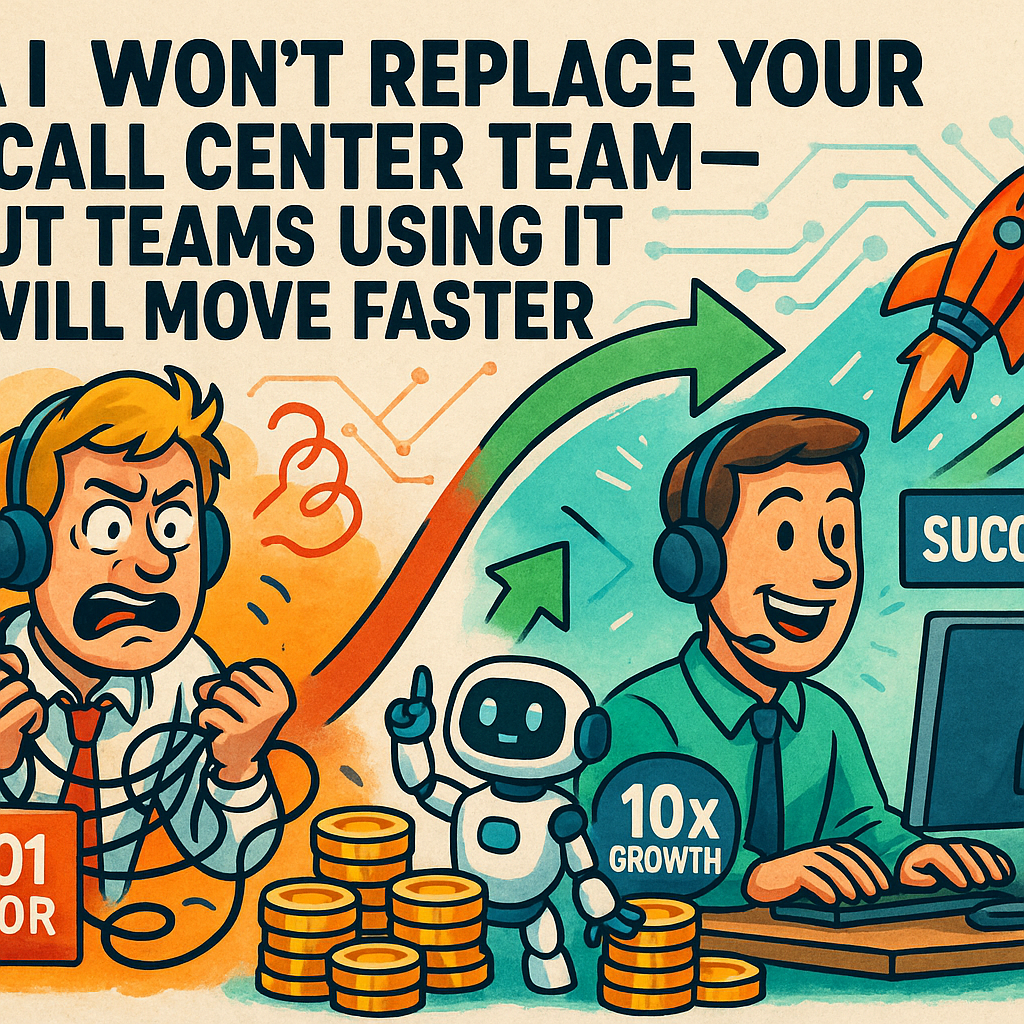
Call center productivity is often discussed as if it were a race against the clock: handle more calls, reduce wait times, and resolve every customer issue faster. But the future of digital customer service is not about pushing agents harder. It is about giving them better tools. As a visionary entrepreneur, I believe the biggest barrier to productivity is not a lack of effort—it is outdated thinking. From fears that artificial intelligence will eliminate jobs to assumptions that automation makes conversations impersonal, several common myths are holding call center operators back. The reality is simpler: when used strategically, AI can help your team focus on the work that matters most.
Myth 1: AI will replace call center agents
This is the fear that gets the most attention, but it misses the point. AI is not a complete substitute for human judgment, empathy, or creativity. Customers still want to feel heard, particularly when they are frustrated or dealing with a complicated problem.
What AI can do is take care of repetitive, time-consuming tasks. It can help qualify leads, organize customer information, suggest responses, summarize conversations, and identify the next best action. That gives agents more time to handle nuanced interactions instead of searching through systems or repeating basic processes.
The most productive call centers will not be human versus AI. They will be human teams equipped with AI.
Myth 2: Automation makes customer conversations impersonal
There is a major difference between careless automation and thoughtful automation. A poorly designed system can frustrate customers with irrelevant responses and endless menus. A well-designed digital workflow, however, can make service feel faster and more relevant.
When AI provides an agent with the customer’s history, previous concerns, preferences, and likely needs, the conversation can become more personal—not less. Agents no longer need to ask customers to repeat information they have already provided. They can begin with context and move directly toward a solution.
Personal service is not defined by whether every task is completed manually. It is defined by whether the customer feels understood. AI can help agents deliver that experience consistently.
Myth 3: AI is only useful for large enterprises
Many call center operators assume advanced technology requires a large budget, a dedicated IT department, and months of implementation. That may have been true for some legacy platforms, but digital tools are becoming more accessible every day.
Cloud-based solutions allow teams of different sizes to adopt capabilities that were once reserved for major corporations. Instead of rebuilding an entire operation, a call center can begin with a specific challenge—such as outbound prospecting, lead follow-up, or contact management—and expand from there.
For growing businesses, this flexibility matters. Productivity improvements do not always come from adding more people. Sometimes they come from helping the existing team spend less time on low-value tasks and more time creating results.
Myth 4: More calls automatically mean better performance
Volume is an easy metric to measure, but it is not always the best measure of productivity. An agent who makes hundreds of poorly targeted calls may generate less value than an agent who has a smaller number of meaningful, well-timed conversations.
This is where ai-powered sales outreach can make a real difference. AI can help teams prioritize contacts, identify promising opportunities, personalize outreach, and follow up consistently. The goal is not simply to increase activity. It is to improve the quality and timing of every interaction.
When call center operators move from “more calls” to “more productive conversations,” performance becomes easier to sustain. Agents feel less pressure to rush, prospects receive more relevant communication, and managers gain clearer insight into what is working.
Myth 5: Implementing AI means changing everything at once
Transformation does not have to be disruptive. In fact, the smartest approach is often incremental. Start by identifying the bottleneck that consumes the most time. Is it manual dialing? Follow-up management? Data entry? Inconsistent scripts? Once that problem is clear, introduce technology that addresses it directly.
Give your team time to learn, test, and provide feedback. Measure practical outcomes such as contact rates, response times, conversion quality, and agent satisfaction. This turns AI adoption into an operational improvement rather than a confusing technology project.
The future belongs to call centers that experiment intelligently, not those that wait for perfect certainty.
Productivity starts with a better definition of work
The best call center operators understand that productivity is not about keeping people busy every minute. It is about removing friction so people can do their best work. AI can handle predictable tasks, surface useful information, and help teams act with greater speed and confidence.
That shift creates a stronger role for human agents. They become problem-solvers, relationship-builders, and trusted advisors rather than operators trapped in repetitive workflows. For customers, it means faster and more thoughtful service. For businesses, it means a scalable operation built for the digital age.
AI is not a threat to the call center of the future. Used well, it is the foundation that allows human talent to go further. Start Using ezDial Today: https://ezdial.ai/prices/