
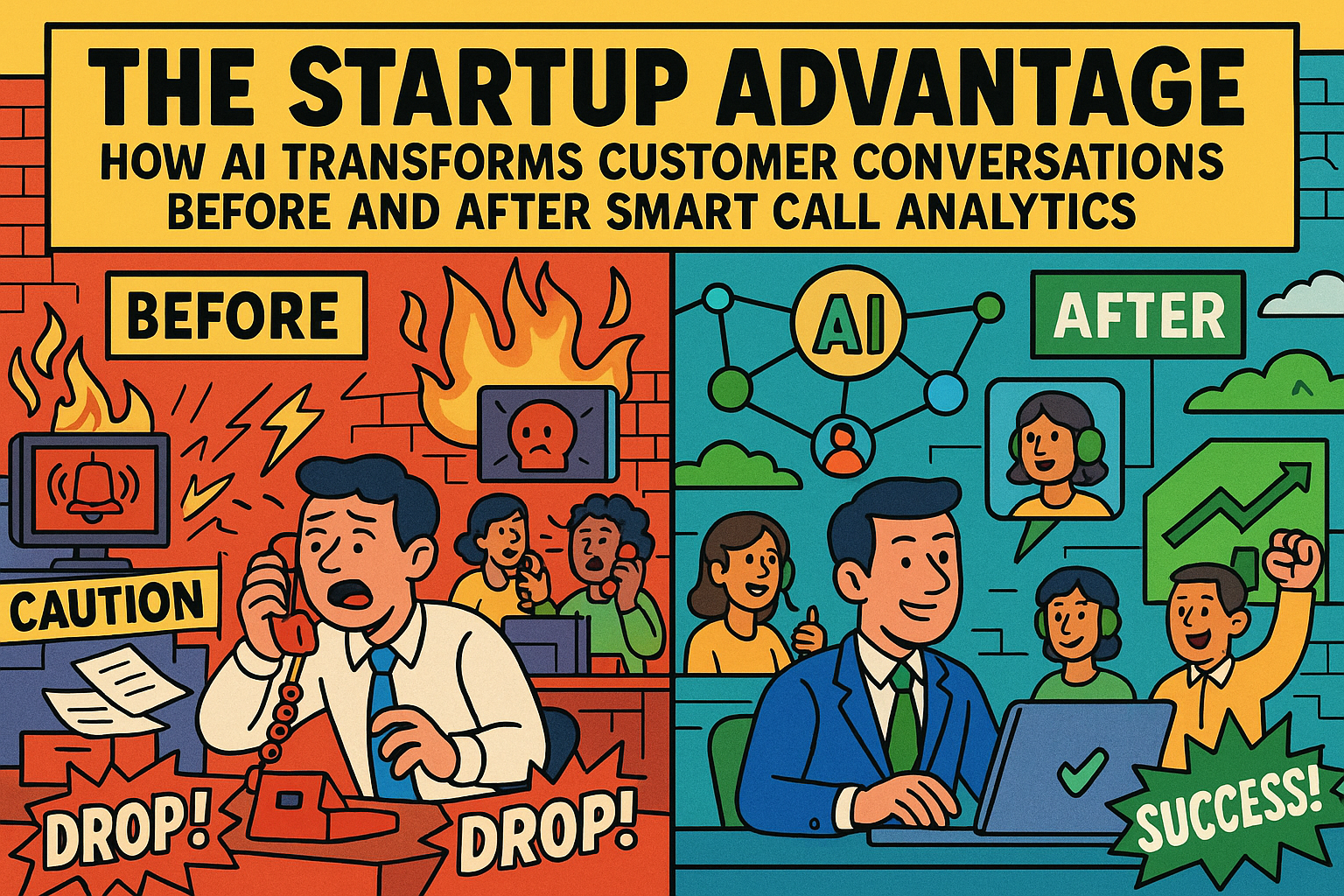
In the world of startups, every interaction with a potential customer counts. Whether it’s a discovery call, a demo, or a support chat, the insights you extract from these conversations can determine whether your company grows—or stalls. Artificial Intelligence (AI) has evolved from being a futuristic concept into an everyday business weapon that startups are using to gain an edge. At the heart of this revolution is one essential tool: the call analytics dashboard. In this post, we’ll explore the “before and after” effect of integrating AI-powered call analytics into your startup operations, showing how conversations that once went unnoticed can now become catalysts for smarter decisions and sustainable growth.
Before AI: Customer Conversations as Missed Opportunities
Before intelligent call analytics came into play, startups often treated customer conversations as transient events—valuable in the moment but impossible to systematically analyze. Founders and early team members wore many hats, jumping from product development to sales to customer support. While those early calls were packed with actionable insights, the lack of time and tools meant vital data slipped through the cracks.
Common challenges included:
- No central repository: Calls were recorded, if at all, and stored across different platforms without consistent labeling or searchable transcripts.
- Limited visibility: Founders depended on gut feelings rather than hard evidence to evaluate sales performance or customer satisfaction trends.
- Reactive management: Issues like lost leads, delayed follow-ups, or recurring customer complaints were addressed only after they became serious.
- Inefficient onboarding: New sales or support hires had no structured references or examples to learn from, extending their ramp-up time.
In short, startups were operating in the dark—relying on anecdotal feedback instead of quantitative insights. That “before” picture represents countless missed opportunities to turn conversations into knowledge, and knowledge into growth.
The Rise of AI-Powered Call Analytics
Then came the breakthrough: AI-driven call analytics. These systems use advanced speech recognition, natural language processing (NLP), and machine learning to automatically transcribe, categorize, and interpret conversations. Rather than manually reviewing calls, founders and operations teams now have a real-time understanding of what’s happening across all customer touchpoints.
Think of an AI-powered call analytics dashboard as the command center for your communication ecosystem. It captures what your customers are saying, how your team is responding, and even the emotional tone throughout the conversation. It converts unstructured voice data into visual insights that reveal patterns you could never spot at scale otherwise.
After AI: Empowered Leaders, Smarter Decisions
Now, let’s paint the “after” picture. Once startups embrace intelligent call analytics, several transformative changes follow almost immediately:
- Data-driven sales optimization: Instead of guessing why some deals close while others stall, founders can review analytics to see which phrases, objections, and follow-up tactics correlate with successful conversions.
- Real-time performance coaching: AI dashboards identify talk-to-listen ratios, key sales moments, and sentiment shifts. Leaders can coach teams based on real interactions rather than relying on intuition.
- Customer-centric product development: Voice-of-the-customer analytics uncover repeated feature requests or sources of confusion, feeding directly into product roadmaps.
- Enhanced compliance and consistency: Calls can be automatically tagged for compliance checks, ensuring legal requirements and quality standards are met—even as your customer base grows.
AI doesn’t just reveal what happened; it explains why it happened and helps predict what will happen next. The shift from reaction to prediction defines the post-AI era for startups.
How Founders Can Leverage Call Analytics for Growth
Startup founders juggle multiple priorities, and efficiency is everything. Here’s how to practically apply AI-driven call analytics within your startup framework:
- Incorporate call analytics early: Even if your team is small, integrating a call analytics dashboard lays the foundation for scalable insights later. Every early conversation becomes future data gold.
- Automate routine insights: Configure your AI tool to automatically flag mentions of competitors, critical feature feedback, or upgrade interest so you can strategize proactively.
- Align cross-functional teams: Share call analytics dashboards with marketing, product, and customer experience teams. When everyone listens to customer sentiment, alignment naturally improves.
- Use sentiment analysis for prioritization: Identify which customer segments are most satisfied—or most frustrated—and tailor your outreach and product improvements accordingly.
- Close the feedback loop: Feed customer call insights directly into product updates and marketing messaging to create a seamless, customer-first cycle.
Before vs. After AI: A Comparative Snapshot
| Aspect | Before AI | After AI |
|---|---|---|
| Conversation Storage | Disorganized, unsearchable recordings | Structured, indexed, and analyzed in real time |
| Sales Coaching | Based on opinions and limited observations | Data-driven, precise, and continuous |
| Customer Feedback | Sporadic and anecdotal | Quantified sentiment and recurring themes automatically extracted |
| Decision Making | Gut-based and reactive | Insight-driven and predictive |
| Scalability | Challenging as call volumes grow | Effortless through automation and AI summarization |
Real-World Scenario: The Startup Turnaround
Imagine a SaaS startup that struggles with high churn and inconsistent sales close rates. Before implementing AI analytics, they relied on meeting notes and informal feedback to understand why deals fell through. Support tickets increased, but the root cause remained unclear.
After integrating an AI-powered call analytics dashboard from ezdial.ai, they began to uncover hidden gems in their data. They realized their sales team was overemphasizing technical jargon with non-technical prospects, causing confusion and drop-off. Simultaneously, sentiment analysis revealed frustration among existing users around setup complexity. Armed with this data, they redesigned their onboarding process, clarified product positioning, and introduced targeted training for sales reps. Within three months, conversion rates improved by 25%, and churn dropped by 18%—a tangible demonstration of how AI transforms uncertainty into understanding.
The Broader Industry Impact
Startups at all stages—whether seed-funded disruptors or Series B scalers—are quickly realizing that AI analytics isn’t just an enhancement; it’s foundational. As competition intensifies, the difference between success and failure increasingly lies in how well businesses listen to and learn from their customers. Those equipped with AI-powered insights can spot trends, respond faster, and deliver personalized experiences that set them apart.
From an industry perspective, AI-driven call analytics dashboards symbolize a broader shift toward data democratization. Instead of relying solely on data scientists or dedicated analysts, front-line managers, founders, and even investors can interpret call trends visually and act instantly. This accessibility fundamentally transforms organizational agility—one of the startup world’s greatest competitive advantages.
Implementing AI Insights Without Complexity
Contrary to popular belief, adopting AI-powered analytics doesn’t have to be overwhelming. Modern platforms like ezdial.ai simplify the process with plug-and-play integrations and intuitive interfaces. The key steps include:
- Synchronizing your call and CRM data sources.
- Setting up automated call tagging and keyword detection.
- Building customized performance dashboards for different teams.
- Regularly reviewing AI-generated insights to inform strategy.
In essence, you don’t need a data science degree to benefit from data science. AI tools have reached a point of accessibility where any startup can use them to make better, faster, and smarter decisions.
The Future of AI-Powered Startup Communication
Looking ahead, the evolution of AI in startup communications won’t stop at transcription or sentiment analysis. We’re entering an era where real-time conversational guidance, predictive behavior modeling, and automated quality assurance will become standard. Imagine AI suggesting personalized talk tracks during a live demo or automatically detecting compliance risks mid-call—these innovations are not years away; they are months away.
As more startups adopt these tools, the landscape will shift toward hyper-personalized, AI-enhanced dialogue experiences. Those who move early will enjoy competitive intelligence that late adopters can’t easily replicate.
Conclusion: The Competitive Edge of Listening Smarter
The story of AI in startup communications is a story of transformation—from reactive listening to proactive understanding. What was once a blind spot is now a treasure trove of insights. The contrast between “before” and “after” AI is stark: once, startups struggled to keep up with what their customers were saying; now, they can anticipate what customers will need next. For founders striving to grow faster, smarter, and more sustainably, adopting an AI-driven call analytics dashboard isn’t just a good choice—it’s a necessary one.
Start Using ezDial Today: https://ezdial.ai/prices/