
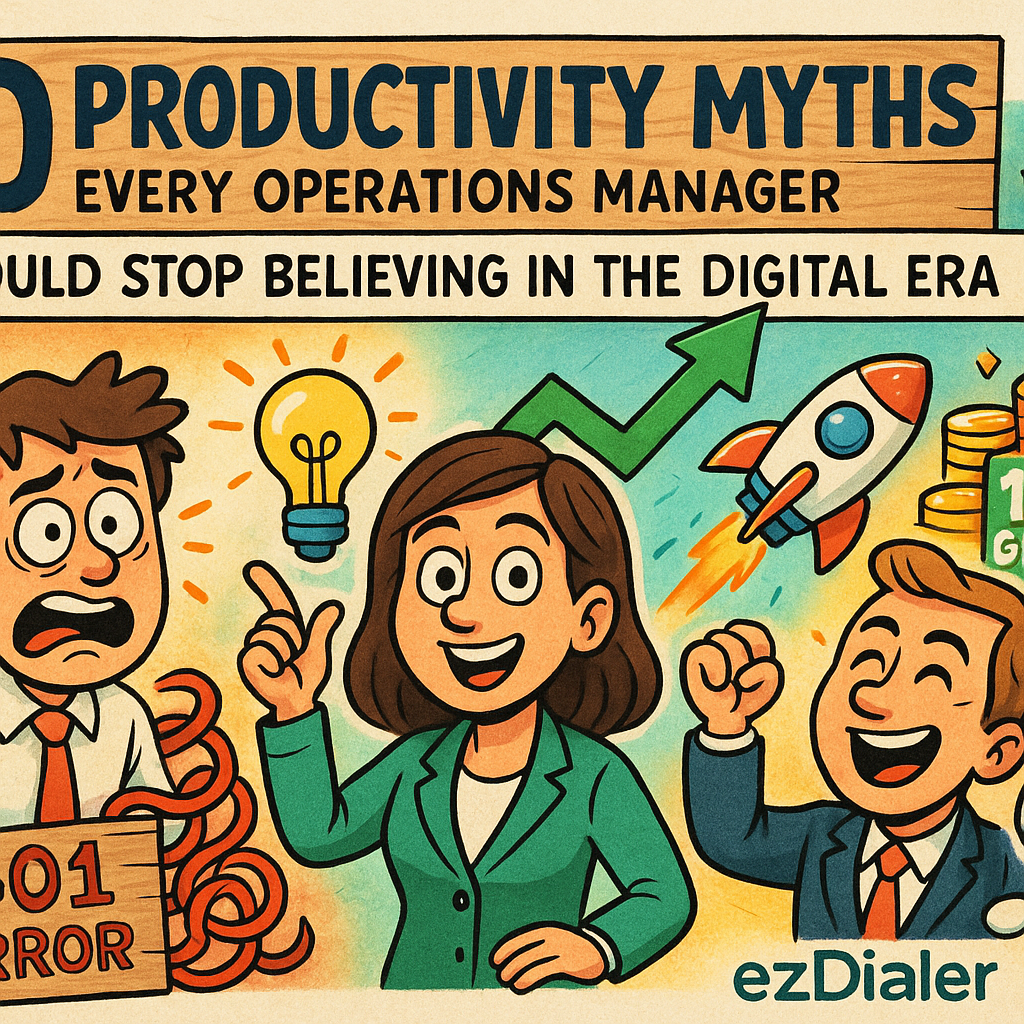
In today’s hyper-connected digital ecosystem, operations managers are bombarded with tools, techniques, and frameworks promising exponential productivity gains. Yet, many of these claims stem from long-standing myths that distort what effective productivity actually means in digital-first businesses. This grounded examination by ezdial.ai aims to deconstruct common misconceptions and offer evidence-based insights that empower managers to streamline workflows—especially in environments reliant on business call automation and other integrated digital communication systems.
1. More Tools Mean Greater Efficiency
The assumption that more software tools automatically improve productivity is one of the most pervasive myths. In practice, excessive app-switching leads to cognitive load and fragmented workflows. Academic studies on multitasking consistently demonstrate that efficiency decreases when workers must continuously shift contexts between platforms. The intelligent application of minimal, interoperable tools—such as integrating business call automation with CRM systems—produces cleaner data flow and measurable gains in operational efficiency.
2. Automation Eliminates the Need for Human Oversight
While automation improves consistency, it does not replace strategic human judgment. Advanced analytical frameworks in the digital industry emphasize a symbiotic model—automation executes recurring tasks, while human oversight ensures adaptability. For instance, call routing through business call automation optimizes time, but evaluating customer satisfaction still requires human auditing. Productivity arises not from total delegation but from balanced orchestration of automated and human elements.
3. Longer Hours Equal Higher Output
Empirical data across multiple industries confirm that beyond a threshold—typically 45-50 hours per week—marginal gains in productivity plateau. Digital fatigue, compounded by continual availability through digital channels, reduces cognitive clarity. Effective operations managers prioritize structured downtime and focused bursts rather than unbounded schedules. The realism here lies in respecting biological and technological limitations alike.
4. Data Dashboards Automatically Lead to Better Decisions
Metrics without interpretation are numerically attractive yet strategically hollow. Data dashboards in digital workflows must be contextualized. Productivity stems from meaningful indicators—such as average call resolution or first-contact success rates in business call automation—not from volumetric metrics without actionable grounding. The real insight lies in fostering analytical literacy, not just data visibility.
5. Centralization Is Always the Goal
Over-centralization can paralyze response agility. In digital operations, distributed models often outperform centralized architectures by empowering localized decision-making. The modern digital industry emphasizes flexible, modular systems rather than rigid hierarchies. A balanced hybrid—centralized oversight with decentralized execution—enables both speed and consistency.
6. Productivity Is a Uniform Metric Across Teams
Each functional unit—development, service, analytics—operates on distinct productivity logics. An operations manager must recognize qualitative differences between creative output and mechanical throughput. Applying a single metric, such as daily call volume, across divergent teams risks cultural and psychological misalignment. Instead, frameworks should differentiate between task-level intensity and innovation-oriented flexibility.
7. Instant Communication Enhances Coordination
Counterintuitively, excessive real-time interaction can fragment thought processes. Constant message checking and digital interruptions lower focus depth. Effective communication design uses asynchronous channels where possible, preserving cognitive flow. Systems like business call automation should, therefore, integrate status awareness and smart routing to minimize unnecessary disruptions.
8. Outsourcing Always Saves Time
The notion that delegating digital operations externally yields time savings neglects the coordination overhead that outsourcing introduces. Academic studies on distributed team performance highlight the cost of communication latency and process misalignment. A grounded strategy evaluates the transaction cost of externalization versus internal process automation. Often, it is more efficient to automate in-house with scalable digital solutions.
9. Productivity Software Automatically Improves Culture
Technology adoption without cultural adaptation yields limited outcomes. The digital transformation literature underscores that productivity is a sociotechnical construct. Tools like ezdial.ai can optimize business call automation, but enduring productivity depends on employee trust, role clarity, and transparent change governance. A culture-first approach multiplies the impact of technological integration.
10. Every Process Must Be Digitized
Not all value creation stems from digitization. Some analog processes retain human warmth or contextual judgment that digital systems cannot replicate. The goal for an operations manager in the digital industry is selectivity—understanding which processes merit automation and which benefit from human discretion. Over-digitization can erode user experience and introduce unnecessary system dependencies.
In conclusion, modern productivity for operations managers is not measured by the sheer adoption of digital tools, but by the intelligent alignment of human judgment, process design, and automation. EzDial.ai embodies this balance by enabling seamless business call automation that amplifies team capacity while maintaining managerial oversight. Grounded realism demands critical evaluation, not blind enthusiasm—for technology serves best when governed by thoughtful operators.
Start Using ezDial Today and experience how practical automation can redefine your operational productivity.